V&A Mused: Building a Digital Product for Generation Alpha
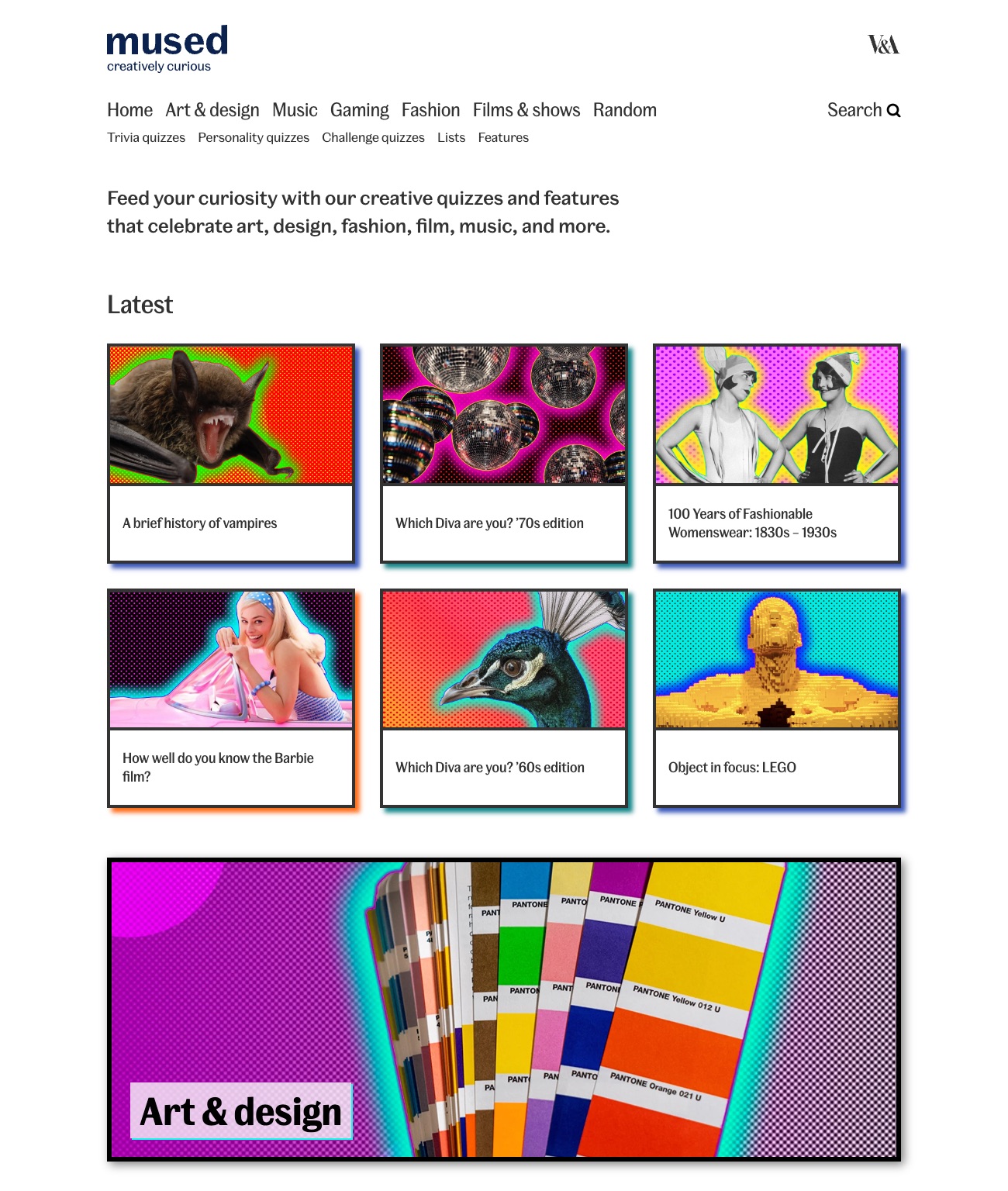
The Brief
In 2022, the V&A set out to create a digital destination for Generation Alpha (young people aged 10–14) that would introduce them to art, design, fashion, music, and creativity. The project was funded by Bloomberg Philanthropies' Digital Accelerator for Arts and Culture, and the ambition was global: reach young people who'd likely never heard of the V&A and might never visit in person.
This was a significant, externally funded multi-year programme. I joined as Project Lead, bringing deep experience in creating digital products for young people and building engagement with hard-to-reach audiences. My role was to help build a team of 5+ alongside external agencies, drive product development, and deliver on time, on budget, and to the highest standards of child safety and accessibility.
Key Metrics
| Metric | Result |
|---|---|
| User Target | Year one goal achieved (100K+ users) |
| Growth | 4x target audience and climbing (as of Jan 2026) |
| Awards | Winner: UK Search Awards 2023 Honoree: Webby Awards 2024 Nominated: Museum + Heritage Awards 2024 Nominated: European Search Awards 2024 |
The Strategic Opportunity
This age group is underserved online: too old for YouTube Kids, but too young for most social media content. Through our research we saw a real gap, and an opportunity for the V&A to fill it.
Museums typically start with their collections when creating digital content. The collection is what makes each institution unique, so it's a natural starting point. But for an audience who've never heard of you, and who are searching for content about Taylor Swift, Minecraft, and fashion aesthetics, collection-first content struggles to find its audience.
The V&A were open to trying something different: creating content that started with what Generation Alpha actually cared about, then finding ways to connect that back to art, design, and the collection. A quiz about "Which Kendrick Lamar album are you?" could introduce young people to the V&A's music and performance holdings. An article about fashion "cores" could connect to 200 years of design history.
The idea was to use pop culture as a way in, creating content around the topics young people were already interested in, then threading connections back to the V&A's world of art, design, and creativity. I'd seen a similar audience-first model work at Beano.com, where broadening the content offer was key to growing the digital audience.
This audience-first approach shaped everything we built.
My Role & The Team
From September 2022 to February 2024, I was Product Lead, working alongside a senior team of highly capable freelancers. Eva Liparova was Product Manager, owning the product build with Big Bite, writing user stories and managing sprint prioritisation. Eva also partnered with Rebekah Ford to shape, run, and analyse the user labs. Rebekah led design, UX, and user testing, and Kim Plowright covered Eva's role on an interim basis. My own focus was product leadership, the SEO-led acquisition strategy, and bringing audience insights from Beano. With the team, we worked across the V&A to ensure content met editorial, UX, accessibility, and technical standards, and I liaised with Bloomberg Philanthropies, whose Digital Accelerator program was designed to help arts organisations thrive through strategic improvements to technology infrastructure.
Team Building & Leadership
Working with Kati Price, Head of Digital Media and Publishing, I helped recruit a specialist team. I co-led procurement with Kati, selecting Big Bite as development agency and SEOMG! for SEO. As Product Lead I set direction and kept things moving across a multi-stakeholder initiative, while Eva owned the agile process, sprint prioritisation, and the day-to-day product build with Big Bite.
Product Strategy & Development
The high-level strategy for Mused was developed by Emma Scott of Cultivation Partners before I joined. My role was to validate, refine, and implement it. Before the project team was recruited, I did significant upfront work with Kati to pressure-test the approach, structure the project, and communicate the concept to stakeholders so we had buy-in before we formally kicked off.
Drawing on my experience at Beano.com, I brought specific learnings around how cultural brands can broaden their digital offer to reach new audiences. From Beano I'd seen the value of a data-driven content pipeline: qualitative research informing content creation, quantitative insight validating what worked, feeding back into the next round of research. I also knew how valuable it is to gather compliant, anonymised insight from a hard-to-reach audience, and pushed to replicate this approach at the V&A.
We established quizzes as the primary acquisition format, an approach I'd seen work as an under-utilised channel for young audiences at Beano. The site also included facts, videos, and challenges, designed as retention drivers to keep users coming back. We chose WordPress as the platform because Mused is fundamentally a publishing proposition, and WordPress gave us the tools to iterate on content quickly and optimise for SEO from day one.
Content Strategy & SEO
I pushed our content strategy towards SEO as the primary acquisition channel. With the focus on organic reach rather than paid marketing, we needed a channel that could work at scale. By taking an audience-first approach and leveraging the V&A's significant domain authority, search became a viable route to reaching young people, particularly through quizzes optimised around topics they were actively searching for. Working with SEOMG!, we built a strategy that met young audiences where they were already looking. It won "Best Use of Search" at the UK Search Awards 2023.
A key part of my role here was sitting between the SEO agency and the V&A content team, translating requirements in both directions. The SEO data told us what to write about, but the V&A's editorial standards meant we couldn't just become a content factory. I made sure we maintained quality while still responding to search demand.
Tom Shreeve led content strategy day to day, with Erica McKoy and Megan Graye creating the quizzes, articles, and challenges that brought the approach to life.
Child Safety & Compliance
Drawing on my experience building digital products for young people, I helped guide the team through implementing COPPA, GDPR, and the ICO's Age Appropriate Design Code. Together we designed privacy-first analytics that gave the V&A meaningful insights without compromising on safety: no ads, no user messaging, no collection of personal data, and fully anonymous optional surveys.
Data & Insights
I pushed for a more data-orientated approach across the project. The team brought strong qualitative research skills, and I complemented this by championing quantitative insight alongside it. I pushed for a soft launch ahead of the full press launch, specifically to gather quantitative data we could act on before wider attention hit.
Working with Sonia Joao at Oxy Insights, I helped translate trend research and user testing into content and product decisions. Our Trendspotter panel (a group of young people) shaped quiz topics and content tone.
A key innovation was "A Random Question", a COPPA/GDPR-compliant insight tool we specified together. This optional feature appeared within quizzes and articles, asking users about their preferences and interests. The questions were completely anonymous and fed real-time quantitative insight back to the V&A, helping inform content decisions while maintaining full privacy compliance.
Handover & Documentation
I co-authored documentation for the permanent V&A team, covering product and technical handover, integrations with V&A services, and domain infrastructure. This gave the in-house team what they needed to continue scaling after my contract ended.
The Process
We started by understanding how Generation Alpha behaves online. Through SEO analysis, trend research, and user testing with Oxy Insights, we identified two key value drivers for this audience: "mastery" (testing and building knowledge) and "social currency" (having things to talk about with peers). These insights directly shaped our content formats and tone.
We ran four rounds of user labs with diverse groups of young people, testing quiz mechanics, navigation, and content. Eva Liparova and Rebekah Ford shaped, ran, and analysed each round, feeding what they learned straight back into the product. From there the team built an interactive WordPress platform with development agency Big Bite, bringing together personality quizzes, trivia challenges, and curated content connecting pop culture to the V&A's collection.
Navigating Challenges
Balancing Content Strategy
There were understandable questions internally about how far the audience-first approach should go. Some stakeholders favoured a heavier V&A content skew, keeping things closer to traditional museum territory. We tested different balances and found that more V&A-focused framing didn't resonate as strongly with the target audience in user testing.
We resolved this collaboratively, maintaining a mix: pop culture content like Taylor Swift and Minecraft quizzes worked as the primary acquisition driver, while V&A-focused content sat alongside it, giving users a route into the collection. We backed the approach with user research throughout. It was great to see this audience-first thinking reflected in the wider V&A when they later ran a Taylor Swift Songbook Trail that attracted significant press.
Editorial Guardrails
An audience-first approach using trend data from young people comes with obvious considerations for a cultural institution. Not everything trending with 10–14 year olds is appropriate for the V&A to publish. Working closely with Tom Windross (Head of Content) and Tom Shreeve (lead content writer on Mused), we established clear editorial frameworks so the content team could move quickly on trending topics while staying within boundaries that upheld the V&A's standards. This involved stakeholder engagement across the organisation to build confidence in the approach.
Technical Infrastructure
A key technical challenge was integrating Mused under the main V&A domain (vam.ac.uk/mused) when the V&A's main site sat on entirely different infrastructure. Working with Kim Plowright, I pushed for this approach because appearing under the V&A domain was essential to leveraging its domain authority for our SEO strategy. This required close collaboration with the V&A's technical team to resolve the integration.
The Outcomes
100K+
Year One Users
4x
Target Growth
Winner
UK Search Awards
Webby
Honoree 2024
The Results
Delivered on Time & Budget
Mused launched in September 2023, on schedule and within budget.
Award-Winning SEO
The SEO strategy won "Best Use of Search" at the UK Search Awards 2023.
Growth Beyond Target
Mused hit its original user target within a year of launch. By January 2026, it had grown to 4x that goal, with continued month-on-month growth.
Post-Launch & Sustainable Handover
After launch, I continued working on product and content iteration, optimising based on real usage data. I managed the handover of relationships with external agencies, trained the in-house team, and ensured they had everything needed to continue scaling independently.
What I'd Do Differently
I'd push to get to soft launch even earlier. We ran a soft launch ahead of the full press launch, and what we learned from real usage data was hugely valuable. The soft launch period ended up being shorter than ideal, and with more time we could have iterated further before the wider audience arrived. On a project like this, getting real quantitative data as early as possible is always worth prioritising.
Awards & Recognition
Mused received recognition across multiple industry awards for its innovative approach to reaching young audiences through search and digital engagement.
Best Use of Search
UK Search Awards
Best Use of Digital
Museum + Heritage Awards
Websites for Cultural Institutions
Webby Awards
Best Use of Search – Third Sector
European Search Awards
The Impact
Mused is now part of the V&A's digital ecosystem, reaching young people across the English-speaking world, with the US now its largest audience. These are people who might never visit the museum in person but are now engaging with art, design, and the V&A's collection through content that meets them where they are.
The project showed that starting with what an audience wants, rather than what you want to tell them, is an effective way to build new relationships. It also demonstrated that child safety compliance and engaging product design aren't in tension. We built real-time analytics, ran user research, and created compelling experiences while fully adhering to GDPR, COPPA, and the ICO Children's Code.
Credits & Thanks
This was a collaborative effort across the V&A and external partners.
V&A
- Kati Price— Head of Digital Media and Publishing
- Fiona Hodge— V&A Product Lead
- Tom Windross— Head of Content
Mused Team
- Eva Liparova ↗— Product Manager
- Kim Plowright ↗— Interim Product Manager
- Rebekah Ford ↗— Design, UX & User Testing
- Tom Shreeve ↗— Content Lead
- Erica McKoy ↗— Content
- Megan Graye ↗— Content
- Big Bite— Development Agency
Specialists & Consultants
- Emma Scott, Cultivation Partners ↗— Strategy Foundation
- SEOMG! ↗— SEO Strategy (UK Search Awards 2023 winners)
- Caspian Turner, Accessible by Design ↗— Usability Reviews
- Sonia Joao, Oxy Insights ↗— Trendspotter Panel & Research