Beano: The Digital Transformation of a British Icon
The Brief
The Beano has been a British institution since 1938. But by the mid-2010s, while the brand was still loved, it was struggling to connect with digital-native young people. DC Thomson invested significantly in Beano Studios to bring the brand into the digital age, with the ambition of transforming a weekly print comic into a daily digital destination for 7–13 year olds.
I joined as a consultant and Senior UX/UI Designer in 2016. Over the next five years I grew with the product, eventually becoming Director of Design & UX with a seat on the senior management team. This was the most formative role of my career, and where I developed much of the thinking around audience-first design, data-driven content, and building digital products for young people that I still apply today.
Key Metrics
100x
Audience Growth
2.4m
Peak Monthly Uniques
14+
Industry Awards
5m
Monthly Reach at Peak
The Strategic Challenge
70% of British parents knew the Beano from their own childhood, but a far smaller number would recommend it to their own kids. The brand had huge residual awareness and love, but it wasn't reaching the generation that mattered most: the 7–13 year olds who spent their time on YouTube, gaming, and social media.
The digital world where young people spent most of their time wasn't made for them. Gaming, YouTube, and social media were largely designed for 13+. Our own research found that less than 20% of parents believed there were enough safe, high-quality digital destinations for their kids. There was a real gap, and the opportunity was to make Beano the brand that filled it.
The challenge was not just building a website. It was figuring out what a digital Beano actually looked like for a generation who'd never read the comic, and then iterating constantly until we found the model that worked.
The Growth Story
My time at Beano spanned three roles across five years. At each stage, the scope of my work expanded as the product and the studio evolved around it.
Phase 1: Senior UX/UI Designer (2016–2018)
I joined to work on the Beano.com relaunch in September 2016. The original plan was for external agencies to handle UX/UI design, with an in-house agile development team and me as the internal design owner. In practice, the agency output didn't land with stakeholders, so I took over the design ahead of launch and recruited an additional designer to help deliver it. This was a compressed timeline, but it meant we had full ownership of the design vision from day one.
The initial site launched with a "daily feed of fun" concept: an infinite-scroll feed inspired by the Snapchat-style paradigm that was popular at the time. It served up a broad mix of content including videos, games, interactive puzzles, quizzes, drawing challenges, and user-generated content tools, with 50 new pieces every week. While we'd validated the concept in user research, the reality was that the infinite-scroll approach didn't translate well to the web. The site had very poor traffic. The feed worked somewhat better on the companion app, but we couldn't drive enough traffic to the app without significant marketing spend.
This was an important turning point. Working with consultant UX designer Lee Whitelock, we simplified the site's information architecture and UX to a more native web paradigm: heavily image-led with minimal copy, clear content-type navigation, and intuitive pathways that let users dive deep or jump between related content. Accessibility was an important part of the development process throughout, using well-structured semantic HTML as a foundation and features like text integrated into videos to benefit all users. This was also the point where I was truly empowered to direct the design, and we built in audience feedback loops including a binary voting system that let young people tell us what they loved in language native to the brand, directly informing daily content decisions.
Crucially, we also shifted how we worked with the content team, moving away from a "build it and they will come" mindset to thinking in terms of what would actually attract an audience. This combination of simplified UX and audience-first content thinking is what unlocked the organic SEO channel and set the stage for everything that followed. Within months of the redesign we saw a 7x increase in monthly traffic, reaching 500,000 unique users across the network and over 2.5 million video views. The redesigned experience went on to win the UXUK Grand Prix for Best User Experience in 2017.
Alongside the website, I worked on a companion app which had a highly engaged audience, and in 2018 I led the design and creative direction of a Beano Alexa Skill in direct collaboration with Amazon, one of the early wave of Alexa Skills designed specifically for young people.
Phase 2: Head of Design & UX (2018–2019)
Having established the design processes and built the foundation during Phase 1, I was well placed to expand the team. I moved from hands-on design into leading the design function across the studio, recruiting UX/UI designers and shaping the team based on what I'd learned about what the product and the studio actually needed. I stayed close to the work throughout, but my focus shifted to directing overall design strategy, establishing scalable processes, and mentoring the growing team. I also built a broader design function to serve the whole studio: graphic design, print, marketing, and brand work alongside digital product.
The defining challenge of this period was finding the content model that actually worked. Our Phase 1 approach had been deliberately broad, and we'd been learning from the data what resonated. User-generated content, which felt like the most natural thing to digitise from the comic's tradition of reader submissions, didn't drive organic traffic with this audience. Video, which the whole industry was pivoting to in 2016-17, proved too hard to use for acquisition and retention, particularly with young people who were already committed to YouTube.
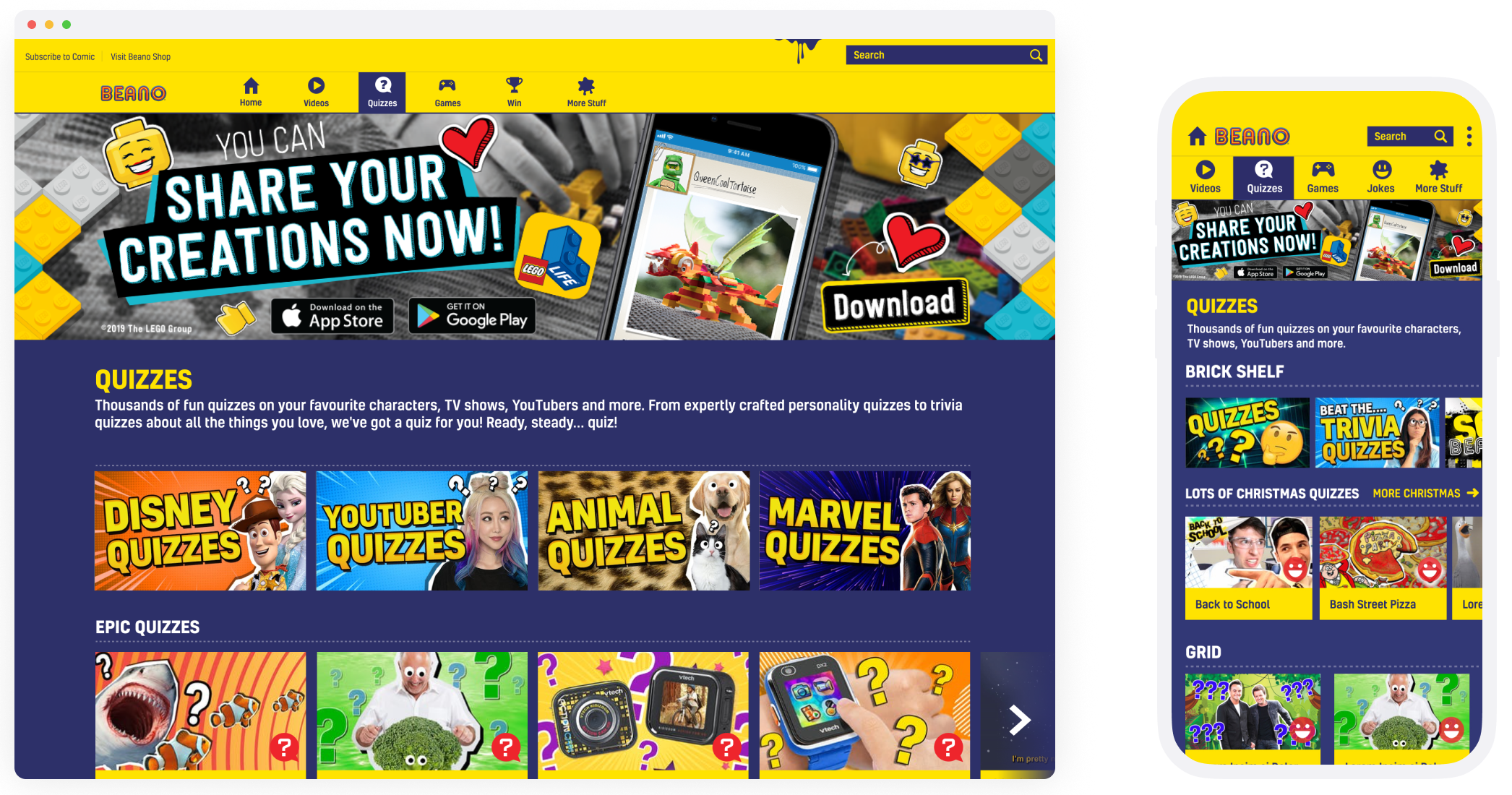
Quizzes were the breakthrough. At the time, the quiz space was underdeveloped, with only Buzzfeed truly meeting their audience with hyper-tailored content. We found that quizzes could be highly reactive in a way video or games couldn't, and crucially they were an organic acquisition channel when optimised around what young people were actually searching for. Once we committed to a quiz-led model, the growth was dramatic: the audience grew roughly 20x over two years, from around 100,000 to over 2 million monthly uniques.
We also had meaningful success with games, briefly ranking in the top five on Google for "Games" with a strategy of quick-turnaround titles that mashed up Beano characters with pop culture. Games felt like the most authentic digital expression of the brand, though quizzes ultimately outperformed them as a growth engine.
There was also important stakeholder work during this period. The website was becoming something very different from the comic, and not everyone was comfortable with that. The relationship was similar to how a newspaper's digital edition evolves into its own product rather than being a reproduction of the print version. The comic and the website shared DNA, but the website needed its own voice and editorial identity to reach a digital audience. Getting stakeholders aligned with this took time and evidence.
Phase 3: Director of Design & UX (2019–2021)
Beano Studios operated as a startup within DC Thomson, a media company of around 800 staff. At its peak, the studio itself was 80–90 people plus freelancers, consultants, and external agencies, covering digital product, content, licensing, consumer products, TV, and live experiences. In my final role I had around 6 direct reports and sat on the senior management team, with budget responsibility for the digital platform. The studio was maturing, and a key part of my work was helping implement a strategic shift from startup-style fast scaling to sustainable long-term growth.
By this stage my role touched much of what the studio produced beyond the digital platform. I was contributing to creative direction across partnerships and TV shows, ensuring brand consistency across licensed products, and advising on physical installations and exhibition stands. This phase was also where I broadened into more strategic work: running workshops, collaborating with other directors and heads of department, and exploring synergies with wider DC Thomson brands like Stylist and Puzzler. I spoke at multiple conferences and industry events, sharing what we'd learned about engaging young people digitally.
One of my last major projects was overseeing the re-platforming of Beano.com from a bespoke React-based CMS to WordPress. This was a significant technical undertaking: migrating 2,000+ pages of content, rebuilding complex custom functionality like our analytics and Beano Brain insight tools, and ensuring nothing was lost in the transition. I worked closely with Angry Creative to push through the harder technical challenges, particularly around ensuring our child-safe analytics setup was faithfully recreated on the new platform. It was a different kind of challenge to the frantic growth phase, but no less demanding.
Data & Insights
One of the things I'm most proud of from Beano is the data and insights infrastructure we built. We called it Beano Brain: a bespoke toolkit that went far beyond basic analytics.
The Insight Pipeline
I was core to building a continuous research pipeline: qualitative research with young people informed content creation, quantitative data from the site validated what was working, and the findings fed back into the next round of research. This cycle ran constantly and was the engine behind the site's growth.
Trendspotter Panel
We ran a panel of 31 young people from diverse backgrounds, interviewed weekly. Over two years, that added up to over 500 hours of interviews. The panel helped us understand trends before they became visible online, because with young people, trends often travel through playgrounds before they show up in search data.
Embedded Research
We collected insight through quizzes, polls, and behavioural data on the site itself. We visited schools regularly and ran face-to-face testing sessions every six weeks. All of this was done within a fully COPPA-compliant framework, developed in close collaboration with PRIVO, a specialist safe harbour and identity consent provider. The site was built as a safe environment with complete security and no data sharing, giving us genuinely useful insight from an audience that most brands struggle to understand.
Being COPPA compliant also had a commercial dimension. Because we could demonstrate that our insight from young audiences was fully compliant and anonymised, it became central to Beano's consultancy proposition and partnership value. Most platforms either ignore young users or lock them out entirely, so having a proven approach to understanding this audience was a genuine differentiator. It's even more relevant now, with growing debate around social media access for under-16s making compliant youth insight increasingly hard to come by.
This approach directly informed the work I later did at the V&A, where I replicated and refined the pipeline for Mused.
The Consultancy
As our expertise in engaging young audiences grew, we launched an internal consultancy arm. Brands came to us for audience research with young people in their own environments, UX audits, content strategy informed by Beano Brain insight data, and hands-on design. The combination of deep qualitative research with young audiences and practical experience building compliant digital products for them was something few other agencies could match.
I led the design and UX consultancy work across high-profile clients including Arsenal and The FA. For Arsenal, we applied the ethnographic research and user testing techniques we'd developed during Beano's digital transformation, working directly with young fans rather than in a testing lab. The key insights informed a more player-centric focus for the Junior Gunners app, including a redesigned home screen and plans for a more dynamic, personalised experience. The FA engagement followed a similar model, applying our testing methodology to a new app for young people.
For each engagement, we took the data-driven, audience-first approach we'd proven on Beano.com and applied it to their specific context. This work demonstrated the commercial value of the expertise we'd built and showed the model was transferable beyond Beano.
E-commerce & Commercial
Beyond the content platform, I was involved in the commercial side of Beano's digital presence. I worked with the wider DC Thomson shop team on optimising the UX of the Beano shop, which was complex as it sat within a shared DC Thomson e-commerce platform customised per brand.
One of the more innovative projects was leading my design team in creating a personalised print-on-demand comic: users could build an avatar on the website and receive a physical Beano comic featuring themselves. It became the top-selling product in the shop after comic subscriptions and was a significant revenue driver, showing how digital engagement could directly feed commercial outcomes.
Awards & Recognition
Beano.com won over 14 industry awards during my time at the studio, recognising both the quality of the user experience and the broader digital transformation of the brand.
Best User Experience (Grand Prix)
UXUK Awards
Best Entertainment / Leisure Experience
UXUK Awards
Best Digital Children's Content
Broadcast Digital Awards
Digital Innovation Award
PPA Awards
Plus additional industry awards throughout 2017–2021.
Conference Speaking
- Building Beano.com — Keynote, UXUK Awards 2018
- Designing an Award-Winning Experience — Bunnyfoot London, March 2018
- UX on the Front Line — London, June 2018
- Designing an Award-Winning Experience — UX Sheffield, July 2018
- How to Get Incredible Insights from Under 13s (with Elizabeth Pinkney, Arsenal) — February 2020
- Design Ethics — UX Crunch, April 2020
The Results
| Metric | Result |
|---|---|
| Audience Growth | Over 100x growth, peaking at 2.4m monthly uniques |
| Reach | 5 million monthly reach at peak, UK's fastest-growing kids site |
| Comic Sales | Print sales up ~10% year-on-year, attributed partly to digital success |
| Awards | 14+ industry awards including UXUK Grand Prix and Broadcast Digital Award |
| Consultancy | Internal agency launched, working with FA, Arsenal, and other brands |
The Impact
Beyond the numbers, we built a model for how to engage young audiences digitally: start with what they care about, use data to constantly refine the offer, and build safe, compliant products that parents can trust. The consultancy work proved the model was transferable across brands and sectors.
Many of the approaches I developed at Beano, from the data-driven content pipeline to audience-first thinking and compliance expertise, directly informed my later work leading product development for the V&A's Mused platform.
What I Learned
Five years is a long time to spend with one product. Looking back, the most valuable things I took from Beano were not specific design decisions but broader ways of thinking.
I learned to let data guide pivots rather than getting attached to a particular vision. We moved through UGC, video, games, and ultimately quizzes as our primary growth driver, and each shift was informed by what young people were actually telling us through their behaviour. The instinct to commit to what the data supports, even when it means abandoning something you've invested in, is something I've carried into every project since. While the audience at Beano was young people, the underlying approach (understand an underserved audience deeply, build around what they actually want, use data to iterate relentlessly) applies to any audience most products aren't designed for.
I learned how to balance creative ambition with commercial reality in a studio that was constantly evolving. Not every piece of work is glamorous. The WordPress re-platforming was as important to the business as the award-winning redesign, just in a different way.
Most importantly, growing from a hands-on designer to a director taught me how to operate at different levels simultaneously. Early on, I was personally responsible for a huge amount: UX, UI, user research, creative direction, and more. That breadth gave me a deep understanding of what the team needed, and I used it to build a design function that could scale. As Head of and then Director, I took on the people management side too, from hiring and mentoring to performance and career development. It gave me a real appreciation for what it takes to keep a team healthy and productive, and it's something I've continued to value in my work since. The lesson I took away is that the best work happens when you can move between strategy and execution fluidly, setting direction for the team while still being close enough to the work to make good calls.